Contrast sensitivity testing measures the faintest contrast at which a patient can distinguish a target from its background. Standard visual acuity asks how small a high-contrast letter the patient can resolve; contrast sensitivity asks how faint a letter of fixed size can become before it disappears. The two measurements answer different questions, and a patient can perform well on one while performing poorly on the other.
What contrast sensitivity actually measures
The everyday visual world is not a black-on-white eye chart. Curbs at dusk, a gray car in fog, facial features in a dim restaurant, steps carpeted in a single color — these are low-contrast tasks. A standard Snellen or ETDRS chart, presented at near-maximal contrast, tells you how the visual system performs under the easiest possible contrast conditions. Contrast sensitivity testing probes how the system performs as those conditions degrade, which is often what the patient is actually complaining about.
That is why the classic dissociation matters clinically: a patient with excellent high-contrast acuity but reduced contrast sensitivity may report genuine, functionally limiting visual difficulty — particularly with night driving and glare — that a normal acuity line does not explain. Contrast testing gives that complaint a measurement.
The Pelli-Robson-style approach
The most widely recognized letter-based method is the approach introduced by the Pelli-Robson chart. Its design inverts the familiar acuity chart:
- Letter size stays constant — large enough that resolution is not the limiting factor
- Contrast decreases step by step — successive groups of letters are progressively fainter against the background
- The endpoint is fading, not blur — the patient reads until the letters can no longer be distinguished from the background
The lowest contrast level the patient reads reliably defines the score. Because familiar letters are used, the task is intuitive for patients, and administration feels like a normal chart reading — just one that dissolves into the background instead of shrinking.
When clinicians reach for it
Contrast sensitivity is typically used as a supplementary measure of visual function rather than a routine screening on every patient. Common situations include:
| Situation | Why contrast testing helps |
|---|---|
| Visual complaints despite good acuity | Quantifies difficulty with dusk, fog, glare, and dim environments that high-contrast charts miss |
| Cataract evaluation | Media opacity can degrade low-contrast performance out of proportion to the Snellen line |
| Glaucoma and optic nerve disease | Adds a functional dimension alongside standard acuity |
| Low-vision assessment | Helps characterize usable vision for rehabilitation planning |
| Driving-related concerns | Night-driving difficulty is classically a low-contrast task |
As with any functional test, results are interpreted in clinical context alongside acuity, examination findings, and the patient's history.
Why the display is part of the test
Here is the part that distinguishes contrast testing from ordinary acuity testing: the stimulus is contrast. On an acuity chart, a slightly miscalibrated display mostly threatens letter size; on a contrast chart, an uncalibrated display, wrong brightness setting, or drifting luminance changes the test itself. Printed contrast charts have the mirror problem — fading and surface wear alter the printed contrast steps over time.
The practical takeaway: a contrast sensitivity test is only as trustworthy as the contrast it actually presents. Whatever system you use, the display conditions — luminance, contrast steps, and testing distance — need to be controlled, not assumed.
How AcuityMaster implements contrast sensitivity
AcuityMaster does not include a Pelli-Robson chart or any scored contrast-sensitivity test. What it provides is reduced-contrast acuity — four optotype contrast levels (25%, 50%, 75%, 100%) — which lets you observe performance below full contrast, but does not yield a contrast-sensitivity score. It is included in the standard chart suite — no separate device or add-on. The platform is designed around the relevant display standards: ANSI Z80.21 luminance requirements (80–320 cd/m²) and the ISO 8596 optotype luminance specification (≤15% of background), with all optotype sizes auto-calculated from the patient-to-screen distance you enter. Because it is digital, the contrast steps do not fade the way printed charts do, and the same exam lane switches instantly between contrast testing, Snellen and ETDRS acuity, color vision screening, and pediatric optotypes. See the full feature list and system requirements.
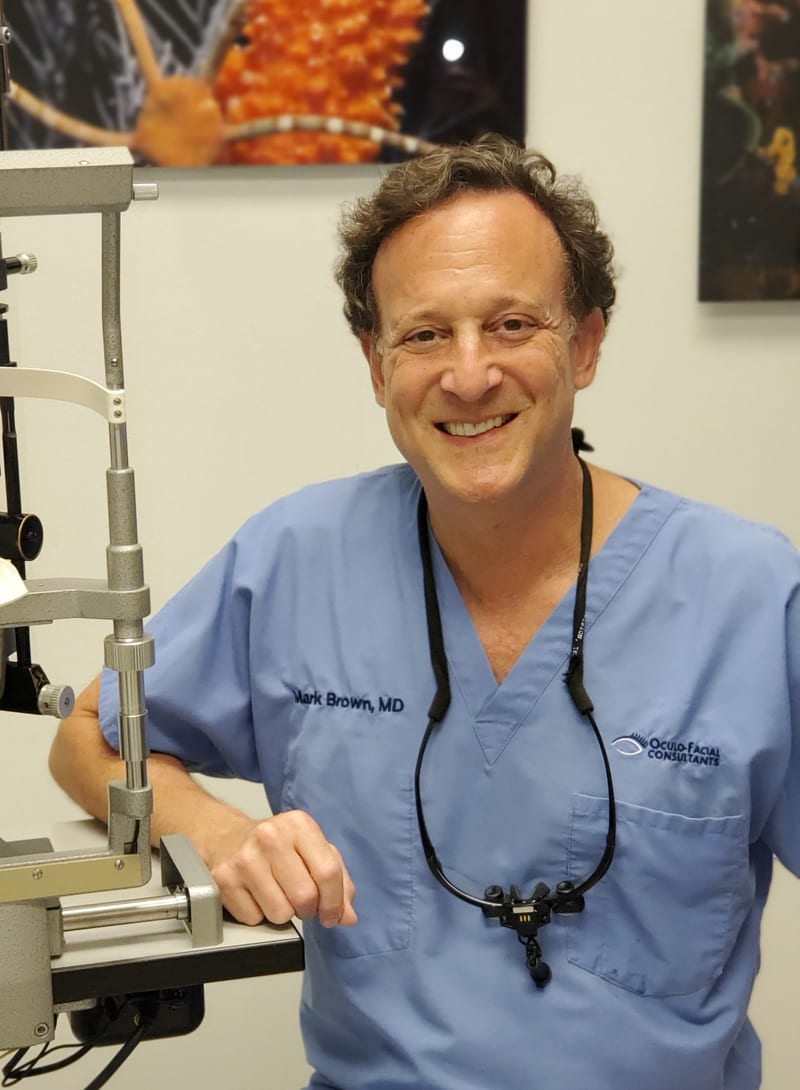
Mark S. Brown, MD
Oculoplastic surgeon at Oculo-Facial Consultants and founder of AcuityMaster. In clinical practice since 1998, Dr. Brown built AcuityMaster to bring properly sized, distance-calibrated acuity testing to every exam lane.