Projector acuity systems are familiar and have served eye care for decades. But when you put the real numbers side by side — hardware, consumables, time, and clinical capability — a software-based digital eye chart comes out ahead for most practices. Here is what the math actually shows over a five-year practice horizon.
The hardware and consumable costs
A projector chart system carries an upfront unit cost plus ongoing bulb replacements. Projector bulbs are not cheap and they dim over time, which quietly degrades contrast and therefore measurement accuracy long before the bulb fails outright. A digital system runs on a monitor you likely already own, with no consumables.
| Over 5 years, per lane | Projector system | Digital software (Cloud) |
|---|---|---|
| Hardware / unit | $1,500–$2,500 (market estimate) | Existing monitor |
| Bulb replacements | $300–$600+ | $0 |
| Software (5 yrs @ $249/yr) | — | ~$1,245 |
| Chart types included | Fixed slide set (Snellen plus a few refraction slides) | Full digital suite, switchable instantly |
On those figures a projector lane runs $1,800–$3,100+ over five years against roughly $1,245 for the software — 31% to 60% less, depending where the projector figures land. And one of them buys a fixed slide set while the other buys the entire testing suite plus updates.
The hidden time cost
Projectors warm up, and switching between the limited charts they offer is slow. Across a busy clinic that runs dozens of patients a day, seconds of fumbling per encounter add up to real chair time. Digital systems present any chart instantly and can randomize letters between patients to prevent memorization, which a fixed projector slide cannot do.
The capability gap
This is where the comparison stops being close. A projector gives you Snellen acuity. A calibrated digital system gives you:
- Snellen and ETDRS/logMAR
- Color vision screening
- Reduced-contrast acuity (four contrast levels)
- Worth 4-Dot and fixation disparity
- Pediatric optotypes (HOTV, Tumbling E, Landolt C, picture optotypes)
- Astigmatic dial, crowding bars, mirror mode, and randomized presentation
To match that with hardware, you would buy several separate instruments. The software consolidates them onto the screen already in your lane.
What a projector cannot do at all
Cost is the argument people reach for first, but it is the weaker one. The stronger case is that several routine tasks are simply outside a projector’s reach:
- Randomizing optotypes between presentations. A projector shows the same fixed slides, and patients seen every four to six weeks memorise them. Memorised lines read as improvement.
- Changing testing distance without changing hardware. A projector is calibrated to its throw. A short lane or a pediatric distance means optical workarounds.
- Presenting single optotypes with controlled crowding. Isolating one letter with defined surround is a slide-by-slide problem on a projector and a keystroke on a display.
- Adding a chart type after purchase. New slides mean new physical media, if the media still exists.
The failure modes differ, and that matters
A projector degrades gradually. Lamp output falls off well before anyone notices, so contrast drops slowly across months and every measurement taken in that window is quietly affected — and no one knows which measurements those were. Nothing announces itself.
A display fails obviously. It works, or it does not, or it is visibly wrong. A failure you can see is a failure you can date, and measurements either side of it can be interpreted. For a test whose value depends on comparability over time, an obvious failure is worth more than a graceful one.
Room constraints run in opposite directions
Projectors need throw distance and darkness. That drives the classic mirror setup, and it means room lighting has to stay low, which is uncomfortable for elderly patients and awkward for anyone taking notes.
A display needs neither. It works in normal room lighting, which suits the rest of the examination, and it takes up wall space rather than lane length — the constraint that actually binds in most practices. Mirror mode is still available where a lane is genuinely short, but it becomes a choice rather than a requirement.
Where a projector still holds up
Being straight about this makes the rest of the comparison worth reading. A working projector in a lane built around it, in a practice with no interest in ETDRS scoring or randomization, is doing its job. If the lamp is fresh, the slides cover what you test, and nobody is monitoring retinal disease over time, the case for replacing it is weak. Equipment that works is not a problem to be solved.
The moment the calculation changes is a lamp failure, a room reconfiguration, adding a lane, or taking on patients who need repeated comparable measurements. That is when the cost of the projector stops being sunk and starts being a decision.
Questions to settle before switching
- What is the real distance in every lane? Measure it; do not assume 20 feet.
- Which chart types do you actually use, and which do you avoid because the projector cannot show them?
- Who configures the room, and who re-checks it after a monitor or an operating-system change?
- Do the lanes need to agree with each other? If a patient can be seen in any room, they do.
- What happens on the day it fails? A spare consumer monitor is a same-day fix. A projector lamp usually is not.
The bottom line: for a similar five-year spend, a projector buys one aging chart type while digital software buys the full clinical suite, eliminates bulbs and warm-up, and keeps improving through updates. The math favors digital before you even weigh the clinical advantages.
Making the switch
AcuityMaster Cloud runs on the Mac or Windows computer already in your exam lane — no projector, no bulbs, no proprietary hardware. A free trial lets you measure the difference in your own clinic before you commit.
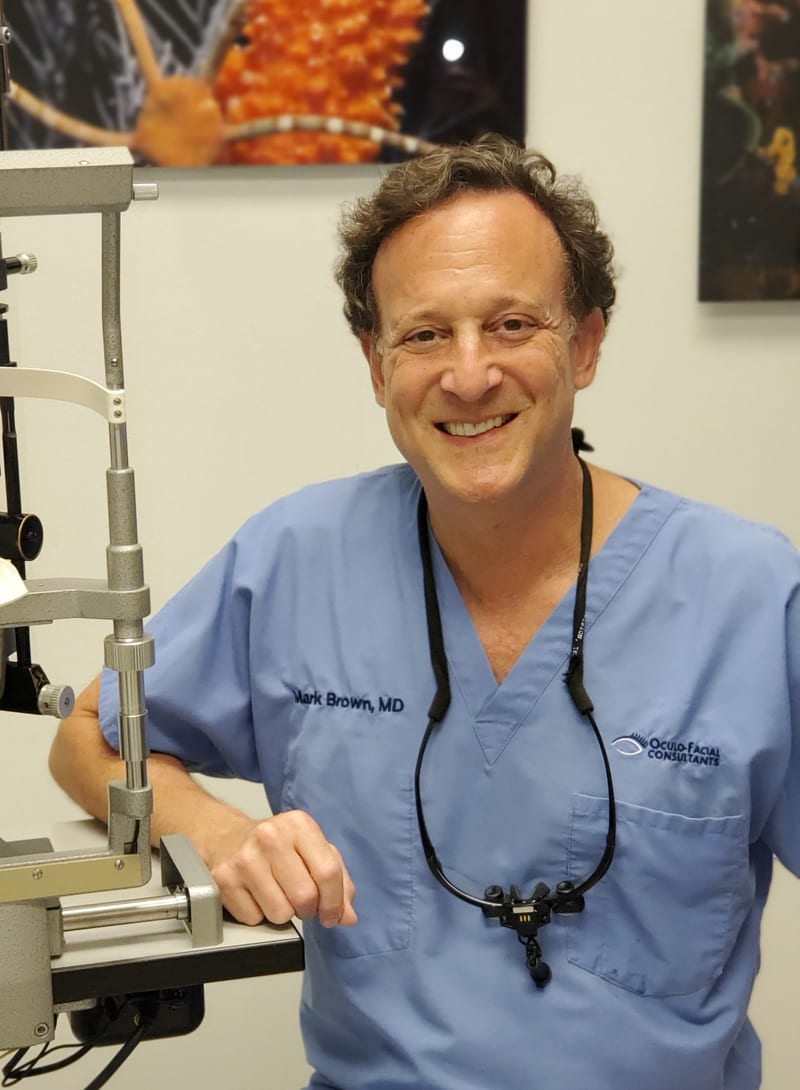
Mark S. Brown, MD
Oculoplastic surgeon at Oculo-Facial Consultants and founder of AcuityMaster. In clinical practice since 1998, Dr. Brown built AcuityMaster to bring properly sized, distance-calibrated acuity testing to every exam lane.