Snellen and ETDRS charts both measure visual acuity, but they are built on different principles and answer different clinical questions. Understanding when to reach for each one — and how to convert between them — keeps your documentation defensible and your measurements comparable across visits.
How the Snellen chart works
The familiar Snellen chart, introduced in 1862, presents a large single letter at the top and progressively more letters per line as acuity improves. Letter sizes step down in irregular increments, the number of letters per line varies, and the spacing between letters is not standardized. This makes Snellen fast and intuitive for routine screening, but it also introduces variability: the 20/20 line has more letters and tighter crowding than the 20/200 line, so the test is not equally difficult at every level.
How the ETDRS chart works
The ETDRS chart was developed for the Early Treatment Diabetic Retinopathy Study to remove that variability. Its design is deliberately uniform:
- Five letters on every row — equal crowding at every acuity level
- Equal logarithmic progression — each row is 0.1 logMAR smaller than the one above it
- Equal spacing between letters and rows, proportional to letter size
- Letter-by-letter scoring — each of the 5 letters is worth 0.02 logMAR, giving finer resolution than line-by-line Snellen scoring
Because every line is equally difficult, ETDRS produces more reproducible measurements — which is exactly why it is the required standard for clinical trials and longitudinal disease monitoring.
When to use each
| Use Snellen for | Use ETDRS / logMAR for |
|---|---|
| Routine acuity screening | Retinal disease monitoring (AMD, diabetic retinopathy) |
| Fast throughput clinics | Anti-VEGF treatment response tracking |
| General refraction checks | Clinical trials and research protocols |
| Patients with normal vision | Low-vision and small inter-visit change detection |
Converting between Snellen and logMAR
logMAR (the logarithm of the minimum angle of resolution) is the score derived from ETDRS testing. The conversion is fixed:
| Snellen (US) | Snellen (metric) | logMAR |
|---|---|---|
| 20/200 | 6/60 | 1.0 |
| 20/100 | 6/30 | 0.7 |
| 20/40 | 6/12 | 0.3 |
| 20/20 | 6/6 | 0.0 |
| 20/16 | 6/4.8 | -0.1 |
A lower logMAR is better, and 0.0 logMAR equals 20/20. A change of 0.1 logMAR corresponds to one ETDRS line — or five letters.
The practical takeaway: use Snellen for speed and ETDRS for precision. If you monitor retinal disease or contribute to research, ETDRS/logMAR is not optional — its equal-difficulty design is what makes a 5-letter change clinically meaningful.
How AcuityMaster handles both
AcuityMaster includes both Snellen (US, metric, and decimal notation) and full ETDRS/logMAR charts in one application, calibrated to your exact patient-to-screen distance and meeting ANSI Z80.21 and ISO 8596 standards. You can switch between them instantly without changing hardware, so the same lane supports a fast screening and a research-grade measurement on the next patient.
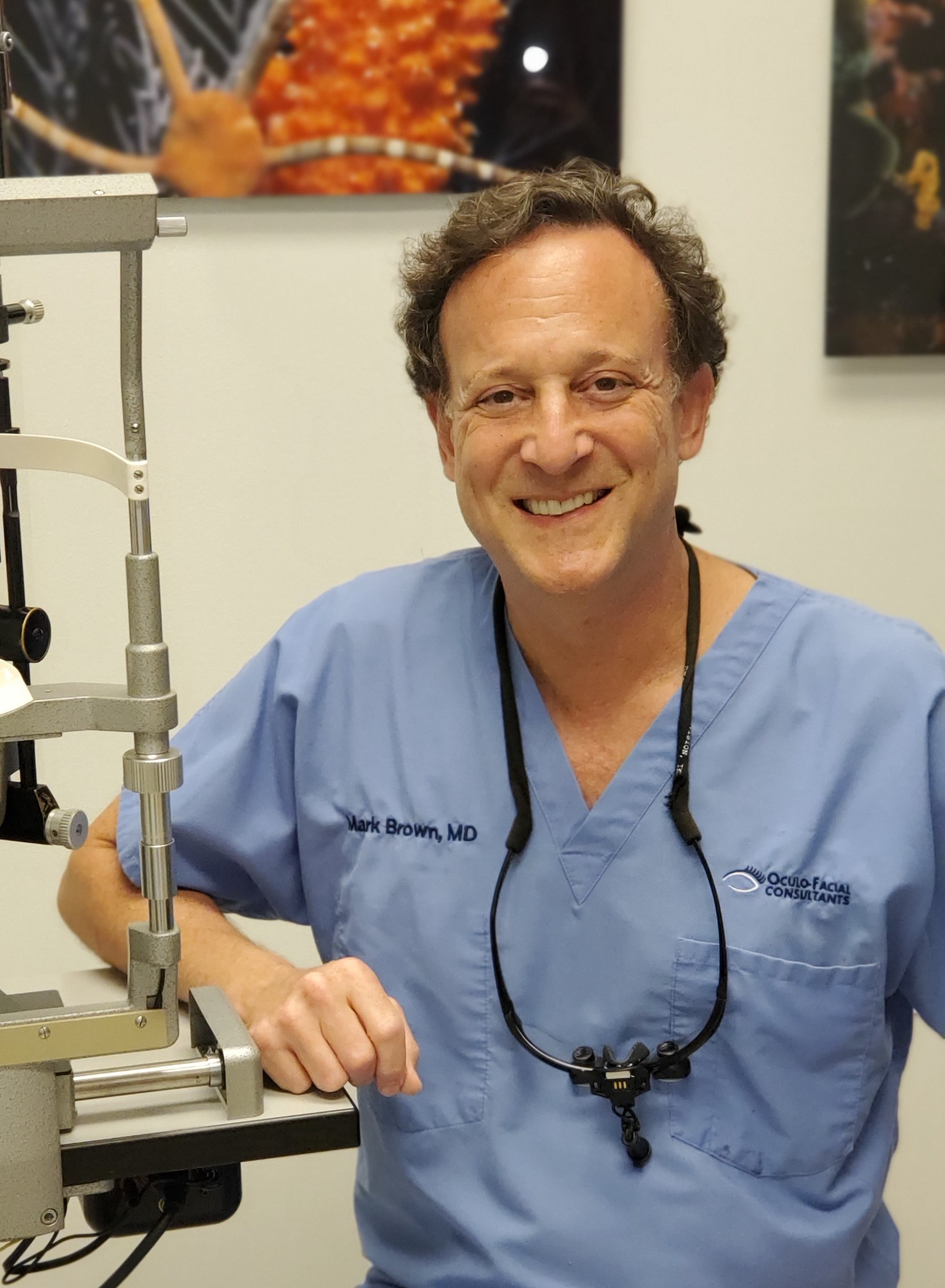
Mark S. Brown, MD
Oculoplastic surgeon at Oculo-Facial Consultants and founder of AcuityMaster. In clinical practice since 1998, Dr. Brown built AcuityMaster to bring standards-compliant acuity testing to every exam lane.