Testing a child's vision is as much about matching the optotype to the child's developmental stage as it is about the eyes themselves. Choosing the right chart is the difference between a reliable measurement and a frustrated, uncooperative patient. Here is how the major pediatric optotypes compare and when to use each.
Lea Symbols
Note: LEA SYMBOLS® is a registered trademark of Lea-Test Ltd. AcuityMaster does not include LEA Symbols. This section is educational; for preverbal children AcuityMaster provides HOTV, Tumbling E, Landolt C and picture optotypes.
Lea Symbols (circle, square, house, apple) are designed for preverbal and preliterate children, generally from about age 3. Children can name the shapes or point to a matching card, which removes the need to know letters. The symbols are calibrated to blur equally at threshold, making them well-validated for clinical acuity measurement in young children.
HOTV
The HOTV test uses only the letters H, O, T, and V — chosen because they are symmetric and easy to match. It works well for children roughly ages 2.5 to 5 who can match letters on a response card even if they cannot name them. HOTV is widely used in amblyopia screening and research protocols such as the Amblyopia Treatment Studies — see our ATS-HOTV protocol guide for how those studies use single crowded HOTV optotypes.
Tumbling E
The Tumbling E presents the letter E rotated in four directions; the child indicates which way the “legs” point. It requires the child to understand and communicate direction, so it suits slightly older or more cooperative children. It is useful for patients who are nonverbal or do not share the examiner's alphabet.
Landolt C
The Landolt C — a ring with a gap in one of several positions — is the ISO 8596 reference optotype. The child identifies the gap direction. Because it is a single standardized shape with defined geometry, it is favored in research and for international standardization, though it demands good directional reporting.
Choosing by age and ability
| Optotype | Typical age | Response method | Best for |
|---|---|---|---|
| Lea Symbols | 3+ | Name or match | Preverbal / preliterate children |
| HOTV | 2.5–5 | Match to card | Amblyopia screening, research |
| Tumbling E | 4+ | Point direction | Nonverbal or non-alphabet patients |
| Landolt C | 5+ | Identify gap | Standardized / research testing |
Don't forget crowding
Children with amblyopia often read isolated letters far better than letters in a row — the “crowding phenomenon.” Using crowding bars or a full line rather than single optotypes is essential for detecting amblyopia, which a single-symbol test can miss entirely.
Matching the test to the child, not the age on the chart
Age bands are a starting point, not a rule. A verbal three-year-old may manage matching tasks that a shy five-year-old will not attempt, and the fastest way to lose a pediatric measurement is to begin with a test the child is going to fail. Start one step easier than the age suggests; moving up is easy, recovering a child’s cooperation after a failure is not.
Two questions settle the choice faster than any table. Can the child reliably name or match shapes? And will they engage with a stranger at four to six feet? A child who says nothing to you may still point confidently at a matching card held by a parent.
Matching cards change the test
Any optotype set that requires naming becomes a matching task the moment you hand the child a card. This is not a compromise — it removes the confound of vocabulary and shyness, and it is standard practice. The card must show the same optotypes at a comfortable size, and the child points rather than speaks.
Have the parent hold the card, not the technician. It moves the social pressure off the examiner, and parents are more patient. Brief the parent first: no coaching, no nodding, no repeating the letter, and no “are you sure?” when the child is wrong.
Testing distance in the pediatric lane
Small children do not stay at 20 feet. Shorter testing distances are normal and legitimate provided the software recalculates optotype size from the actual distance rather than assuming a standard lane — and provided the distance is recorded, because a result at 10 feet is not comparable with one at 20 unless you know which is which.
The practical order is to establish cooperation at whatever distance works, then extend if the child will tolerate it. A completed test at 10 feet beats an abandoned one at 20.
Reading a pediatric result honestly
Pediatric acuity is noisier than adult acuity, and the noise is not symmetric — it almost always makes vision look worse than it is. Fatigue, boredom, and unfamiliarity all push the number down; nothing pushes it up. Treat a single poor result as a reason to retest rather than as a finding.
What matters far more than the absolute number is the difference between the two eyes. Interocular difference is the signal amblyopia announces itself with, and it survives a child having a bad day because both eyes had the same bad day. A two-line difference between eyes deserves attention even when both numbers look acceptable.
Occlusion is where pediatric testing quietly fails. Children peek, and an adhesive patch or a well-held occluder is worth more to the accuracy of the result than any choice of optotype. If a child tilts, turns, or leans during monocular testing, assume they have found a way to see around the occluder.
Practical sequence for a pediatric acuity check
- Decide on naming versus matching before the child is in the chair, and have the card ready.
- Brief the parent on their role, including not coaching.
- Occlude properly. Confirm the child cannot see past it.
- Start well above threshold so the first answer is a success.
- Use crowded presentation for any child being assessed for amblyopia.
- Record the optotype set, the distance, the occlusion method, and the child’s cooperation. The last one is what tells the next examiner whether to trust the number.
Match the test to the child. Start with the most demanding optotype the child can reliably perform, and have a simpler fallback ready. A measurement the child can actually give you beats a “gold standard” chart they cannot.
How AcuityMaster supports pediatric testing
AcuityMaster includes HOTV matching charts, Tumbling E, Landolt C and picture optotypes, plus crowding bars for amblyopia assessment and video fixation targets with USB foot-pedal control for refraction. You can move between optotypes instantly to match each child without swapping cards or hardware.
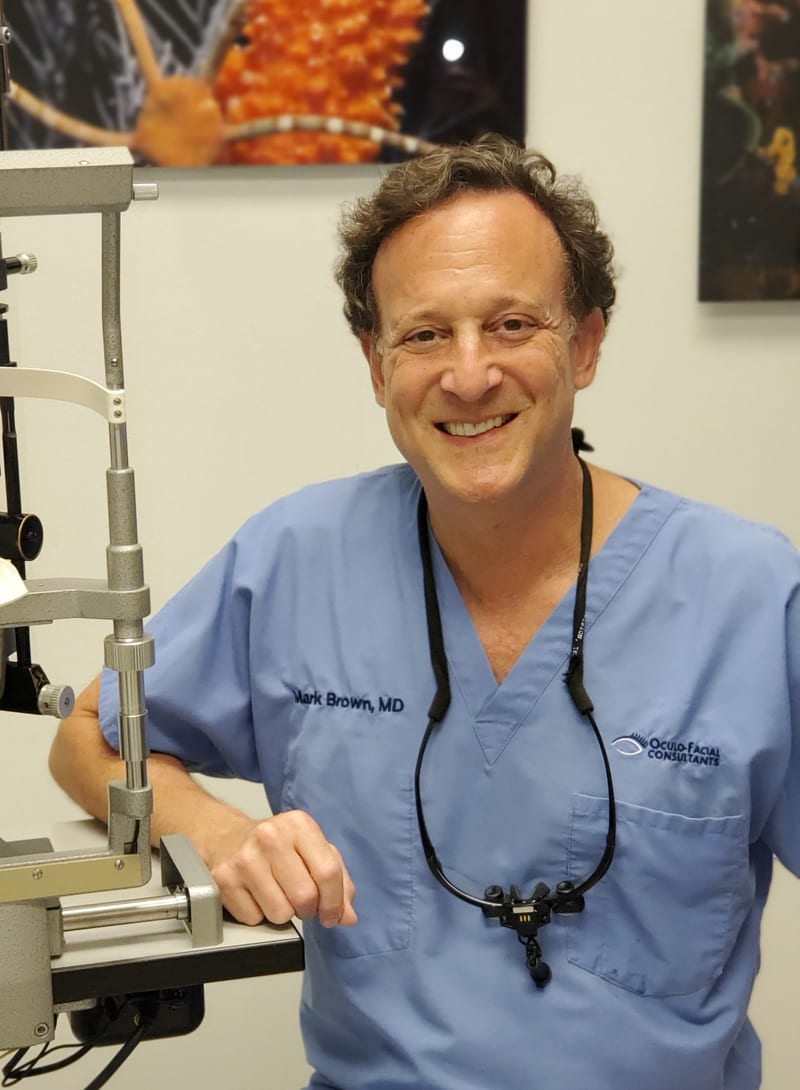
Mark S. Brown, MD
Oculoplastic surgeon at Oculo-Facial Consultants and founder of AcuityMaster. In clinical practice since 1998, Dr. Brown built AcuityMaster to bring properly sized, distance-calibrated acuity testing to every exam lane.